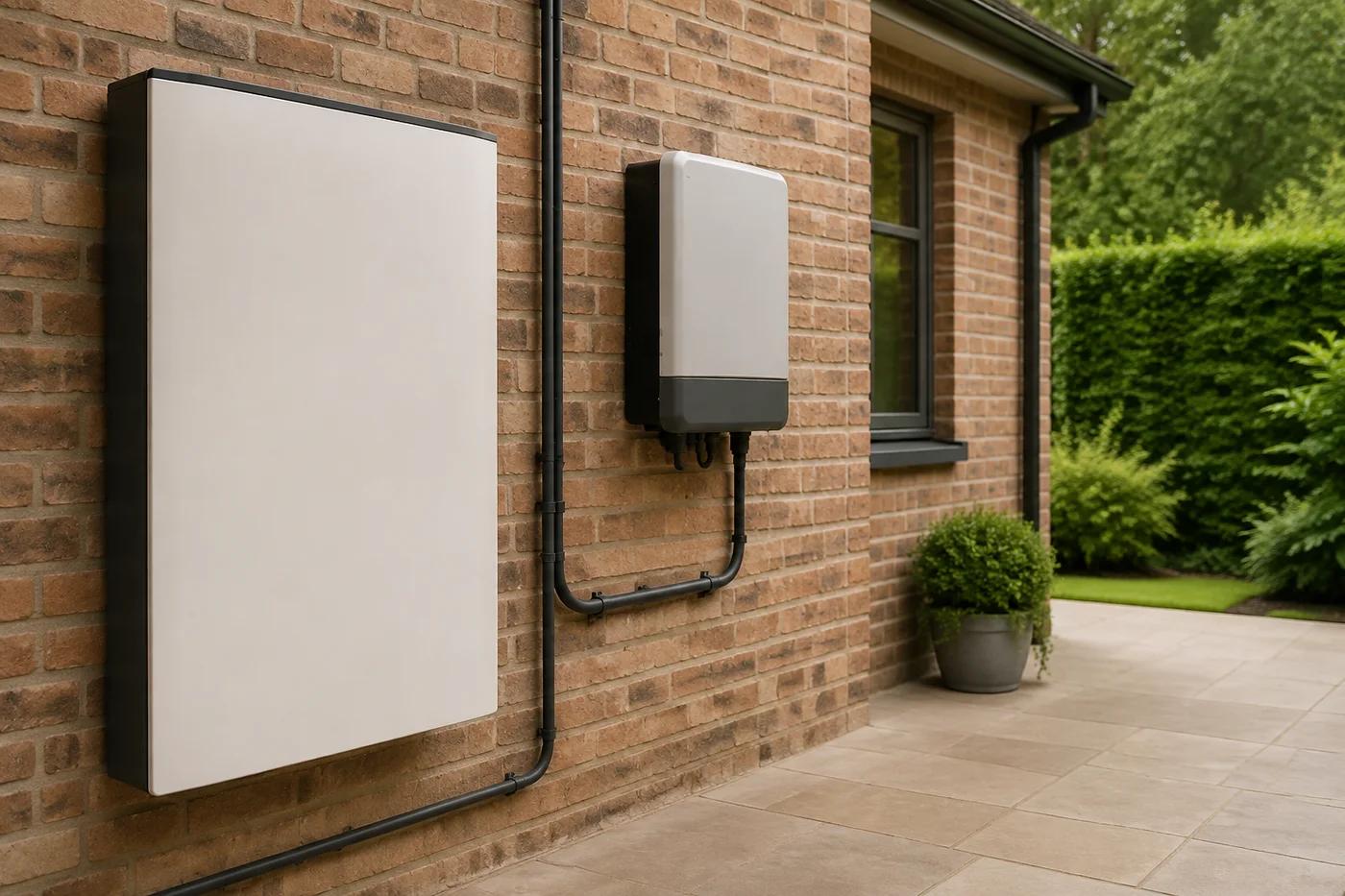
Battery storage · Waltham Cross
Home battery storage in Waltham Cross and the surrounding area
Partner installers can get your next appointment booked within 24 hours of receiving your enquiry.
- 01Usable capacity
- 02Retrofit compatibility
- 03Tariff options
A home battery stores electricity for later use. With solar PV, it can hold surplus daytime generation for cooking, lighting and other evening demand. Some systems also charge from the grid during cheaper tariff periods, subject to compatible controls and tariff terms.
Battery capacity, measured in kWh, describes how much energy can be stored. Charge and discharge power, measured in kW, describes how quickly the battery can take in or deliver electricity. Both matter: a large battery may still need grid support when several appliances run together.
For an existing system, give the installer the panel capacity, inverter model and installation date. Ask them to explain retrofit compatibility, where the battery can be installed and whether changing equipment affects existing warranties or export arrangements. Waltham Cross Solar can connect your enquiry with a partner installer who can get your next appointment booked within 24 hours.
Plan your battery storage installation
For a Waltham Cross household that is away during daylight, compare how much surplus solar could be available and how much electricity is used after returning home. A battery storage system should bridge a measured gap between generation and use. It should not be sized from a commuting label alone.
If the household already has solar, provide the inverter model, installation certificates and current export arrangement. Ask whether an AC-coupled retrofit or hybrid inverter is proposed, what changes to existing equipment are required and how the warranty position is affected.
Brands such as GivEnergy, Tesla Powerwall, Fox ESS and SolarEdge appear in local installer discussions. We claim no manufacturer partnership. Compare the proposed model’s usable kWh, charge and discharge power, warranty conditions, controls and support rather than choosing a battery by its name alone.
The details that shape your system.
Usable storage capacity
Compare usable capacity rather than the headline size alone. Ask how much surplus solar is available to charge the battery through different seasons.
Power for your appliances
Check continuous discharge power against evening demand. A kettle, oven and other loads running together may require extra electricity from the grid.
A suitable installation location
Ask the installer to assess the proposed location against current safety requirements, manufacturer instructions, access and environmental conditions.
Solar and inverter compatibility
A retrofit may use an AC-coupled battery or require changes to a compatible hybrid inverter. Ask for the technical and cost implications of each option.
Warranty and aftercare
Compare warranty duration, warranted energy throughput, capacity retention and exclusions. Check who covers installation labour if equipment needs replacement.
Tariffs and realistic savings
Compare the cost of grid charging, storage losses and export income you would give up. Avoid assuming the same saving every day of the year.
Choose around your energy needs.
Use these starting points to discuss a design with an installer. Equipment, price and suitability are confirmed after assessment.
Combined design
New solar with storage
Price after assessment
Installer assessment required
- PV and storage assessed together
- Battery location included in the survey
- Separate cost for the storage option
Existing solar
Retrofit battery
Price after assessment
Installer assessment required
- Current inverter specification reviewed
- Existing export arrangements checked
- Compatibility and warranty implications explained
Flexible energy use
Tariff-led storage
Price after assessment
Installer assessment required
- Import and export terms compared
- Charge schedules and controls reviewed
- Savings assessed against installed cost
Sources and further guidance
Checked 8 September 2026. Confirm current requirements with the relevant provider or authority.
Your Waltham Cross solar questions, answered.
Is a solar battery worth it?
It depends on installed cost, surplus solar, household demand, tariff rates, losses and the battery’s useful life. Ask for a solar-only comparison and a sensitivity check using different electricity prices. Higher self-consumption does not automatically mean better financial value.
Will a battery keep my home running during a power cut?
Only if the equipment and installation include a suitable backup arrangement. Ask which circuits would be supplied, the available power and how the system changes over. Do not assume every battery provides whole-home backup.
Can a battery charge overnight?
Some systems can charge from the grid on a schedule. Confirm compatibility with your tariff and controls, and compare the off-peak price with losses and the value of exported solar.
Should I choose a particular battery brand?
Compare suitability, usable capacity, power, warranty, monitoring and aftercare before choosing a brand. Ask the installer to explain why the proposed equipment is suitable for your household.
Can I add storage without replacing my solar panels?
Often the panels can remain, but an installer needs to assess the inverter, wiring and connection arrangements. Request a proposal specific to your existing equipment.
Your next step
Let’s see what your roof can do.
Tell us about your property, electricity use and the solar options you would like to explore. Partner installers can get your next appointment booked within 24 hours.