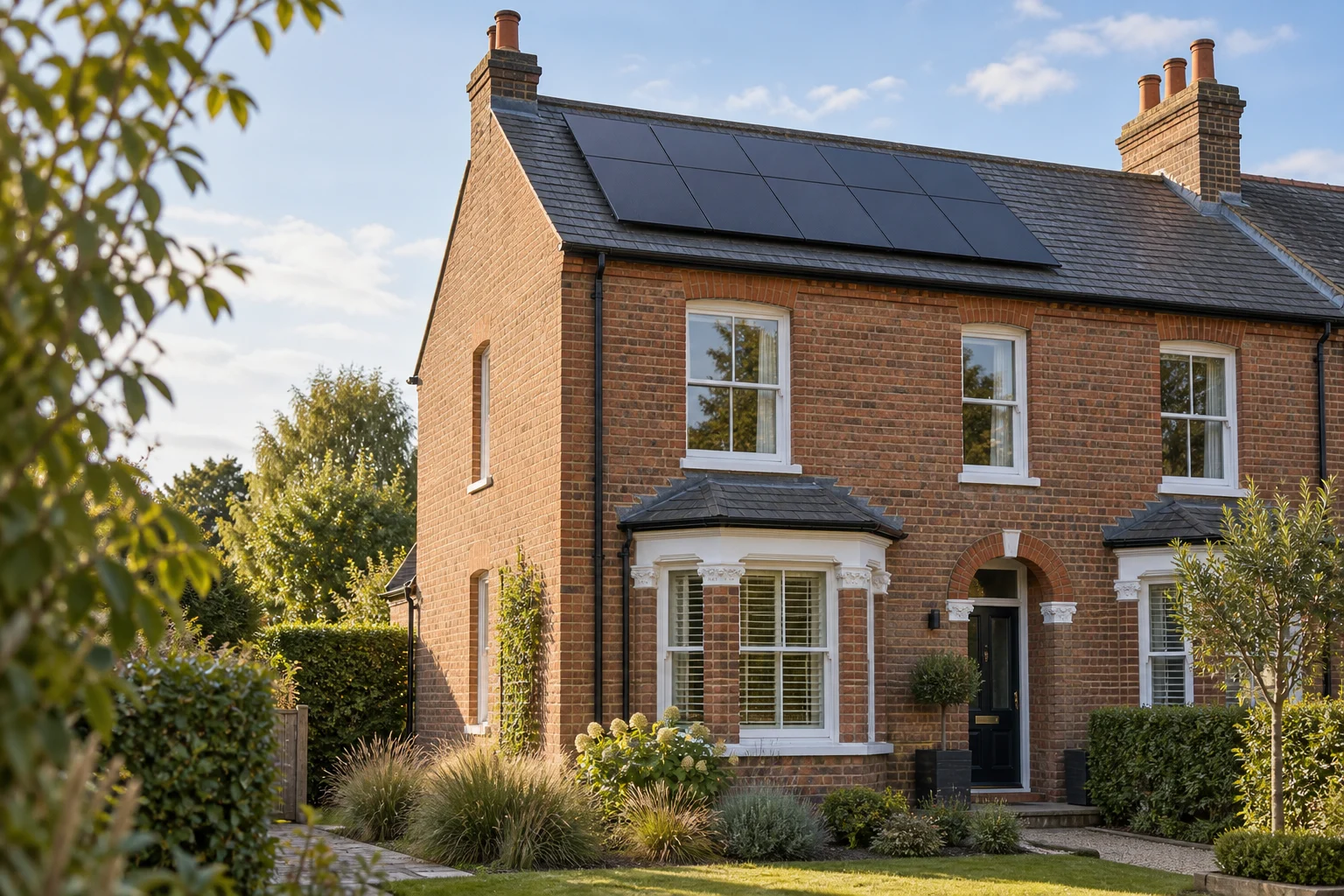
Residential solar · Waltham Cross
Solar panel installation for homes in Waltham Cross
Partner installers can get your next appointment booked within 24 hours of receiving your enquiry.
- 01Roof suitability
- 02System design
- 03Clear installation costs
Solar photovoltaic panels, usually called solar PV, convert daylight into electricity. An inverter converts the panels’ direct current into alternating current for household appliances. Electricity you use as it is generated reduces what you need to buy from the grid; surplus can be stored in a battery or exported.
The right system starts with your annual electricity use, when you are at home and the usable area of your roof. Ask for a layout showing panel positions, shade from chimneys or neighbouring buildings, and an annual generation estimate with its assumptions. A postcode alone cannot establish the performance of your roof.
Waltham Cross Solar connects residential enquiries with partner installers. They can arrange your next booking within 24 hours of receiving your enquiry. The installer confirms survey arrangements, equipment, price and the installation timetable directly with you. Our service covers enquiries from Waltham Cross, Cheshunt and nearby Enfield neighbourhoods.
Solar design for Waltham Cross homes
A roof proposal should account for the building in front of the installer: usable slopes, extensions, rooflights, shade and the condition of the covering. Near heritage assets or within a conservation area, check the relevant council information before finalising the layout. Do not assume every Waltham Cross address has the same restrictions.
For a property near the Enfield boundary, confirm the council using the full address. The installer should explain any grid connection application or notification, often referred to as the G98 or G99 process, and whether prior approval is needed. That process is separate from planning and roof ownership.
Use an itemised solar quotation to compare renewable energy options. Record the PV system capacity, forecast electricity generation, direct household use and export assumptions. Ask how the installation process, monitoring and aftercare will work once the solar panels are fitted.
The details that shape your system.
Roof condition and access
Check the roof covering, structure and scaffolding access before agreeing a layout. If roof repairs are already planned, ask how the work can be coordinated.
Panel layout and shading
Ask how orientation, pitch and shading affect predicted generation. Compare the estimated annual kWh, not only the number of panels or their headline wattage.
Inverter and electrical design
Your installer should explain inverter sizing, cable routes, consumer-unit work and any grid connection process with UK Power Networks.
Battery storage for evening use
A battery stores energy for later. Request separate solar-only and solar-with-battery proposals so you can compare the extra cost with the expected benefit.
Certification and handover
Check the installer’s claimed Microgeneration Certification Scheme (MCS) certification or equivalent evidence, as well as the product and workmanship warranties. Keep commissioning and electrical documents.
A complete written quotation
Ask for panels, inverter, mounting, scaffolding, electrical work and optional extras to be itemised. The savings estimate should separate avoided import costs from export income.
Choose around your energy needs.
Use these starting points to discuss a design with an installer. Equipment, price and suitability are confirmed after assessment.
Daytime use
Solar PV
Price after assessment
Installer assessment required
- Panel layout based on your roof
- Generation estimate with shading assumptions
- Itemised installation and handover scope
Evening use
Solar with storage
Price after assessment
Installer assessment required
- PV and battery sized together
- Usable capacity and power rating stated
- Solar-only comparison included
Future plans
Solar, storage and EV
Price after assessment
Installer assessment required
- Vehicle charging routine considered
- Charger and inverter compatibility checked
- Electrical supply capacity assessed
Sources and further guidance
- Energy Saving Trust: solar panels
- Planning Portal: domestic solar planning rules
- Broxbourne: conservation areas and heritage
- UK Power Networks: solar, storage and EV connections
- Ofgem: SEG guidance for generators
Checked 8 September 2026. Confirm current requirements with the relevant provider or authority.
Your Waltham Cross solar questions, answered.
How many panels will my home need?
Ask the installer to size the system around annual electricity demand, roof space and your plans for an EV or heat pump. System capacity in kWp describes rated power; annual generation in kWh describes energy. Two roofs with the same panel capacity can produce different amounts.
How much will a Waltham Cross installation cost?
Your quote depends on equipment, system capacity, scaffolding, roof access and electrical work. Our cost guide includes a sourced national reference and a comparison checklist. It is not a local fixed-price offer.
Can east- or west-facing roofs use solar?
They can be suitable. Ask for a roof-specific generation assessment that accounts for orientation and shade. A south-facing roof is not the only option.
Do I need planning permission for solar in Broxbourne?
Planning and grid connection are separate checks. Some domestic installations qualify as permitted development. Check property-specific planning questions with Broxbourne Borough Council and ask your installer about the network operator’s connection process.
Who provides warranties and repairs?
Your chosen installer and equipment manufacturers provide the terms for the installation and products. Confirm who handles fault diagnosis, labour, call-outs and any subcontracted work before signing.
Your next step
Let’s see what your roof can do.
Tell us about your property, electricity use and the solar options you would like to explore. Partner installers can get your next appointment booked within 24 hours.